The
Sequenza vii for solo oboe of L. Berio (1969) is an icon for oboists in the contemporary
music for our instrument. At the time it was revolutionary because of the sound
possibilities used in the instrument, besides it was written in such a language.
It has been already commented on many occasions there is usually an influence between
music and painting. A clear example would be the related work of Kandinsky and Schönberg.
In today's
post I'd like to make a personal comparison between the language of the Sequenza for oboe and pictorial features from painters who influenced Berio.
Luciano Berio (1925-2003), Sequenza VII for oboe:
Luciano Berio (1925-2003), Sequenza VII for oboe:

Paul Cézanne (1839-1906)
Impressionism
- Developed an authentic observation of the visible world.
Impressionism
- Developed an authentic observation of the visible world.
- Sort
structurally everything he saw into simple forms and color planes.
- Briefs,
often repetitive, sensitive and exploratory.
- Observe objects from different points of view, what it takes to represent different perspectives simultaneously.
- Observe objects from different points of view, what it takes to represent different perspectives simultaneously.

Comparison with Sequenza vii:
- The structural order forms and planes of the painting resembles the spatial music writing. It is curious the length of the measures in seconds.
- Berio chose new graphics that he believed were necessary to capture the musical idea.
- Brushstrokes can be compared with the first short sound, natural B3. Berio explores or builds musical discourse from this note.
Paul Klee (1879- 1940)
Surrealism, Expressionism and Abstraction
Surrealism, Expressionism and Abstraction
- He used the color in a varied and unique way. At first, less valued the color. It seemed something decorative to him, but changed his mind and finished teaching color theory and mixing.
- Klee worked in many different media (oil paint, watercolor, ink, pastel, etching, and others. He often combined them into one work.
- Often used geometric forms as well as letters, numbers, and arrows, and combined them with figures of animals and people.
- Klee worked in many different media (oil paint, watercolor, ink, pastel, etching, and others. He often combined them into one work.
- Often used geometric forms as well as letters, numbers, and arrows, and combined them with figures of animals and people.

"Senecio" (1922)
Comparison with Sequenza vii:
- Importance of color seeking new timbral sonorities. An example would be the 5 different fingerings for the pitch B3.
- Berio explores new possibilities in the sound of the oboe like a color. New effects appear when little were used (multiphonics, frulato, glissandos, harmonics, double trills, ...)
- The geometric aspect could be compared with the structure of the work. It's like a square of 13 staves and 13 bars.
Jackson Pollock (1912- 1956)
Abstract Expressionism
Abstract Expressionism
- Graphical
shape through a series of processing paint techniques not experienced before.
- Dramatic
and uncontrollable subconscious representation.
- Search to
raise emotions in the expectant audience.
- Mobility
and chaos in a certain order in itself.

"Number 8" (1949)
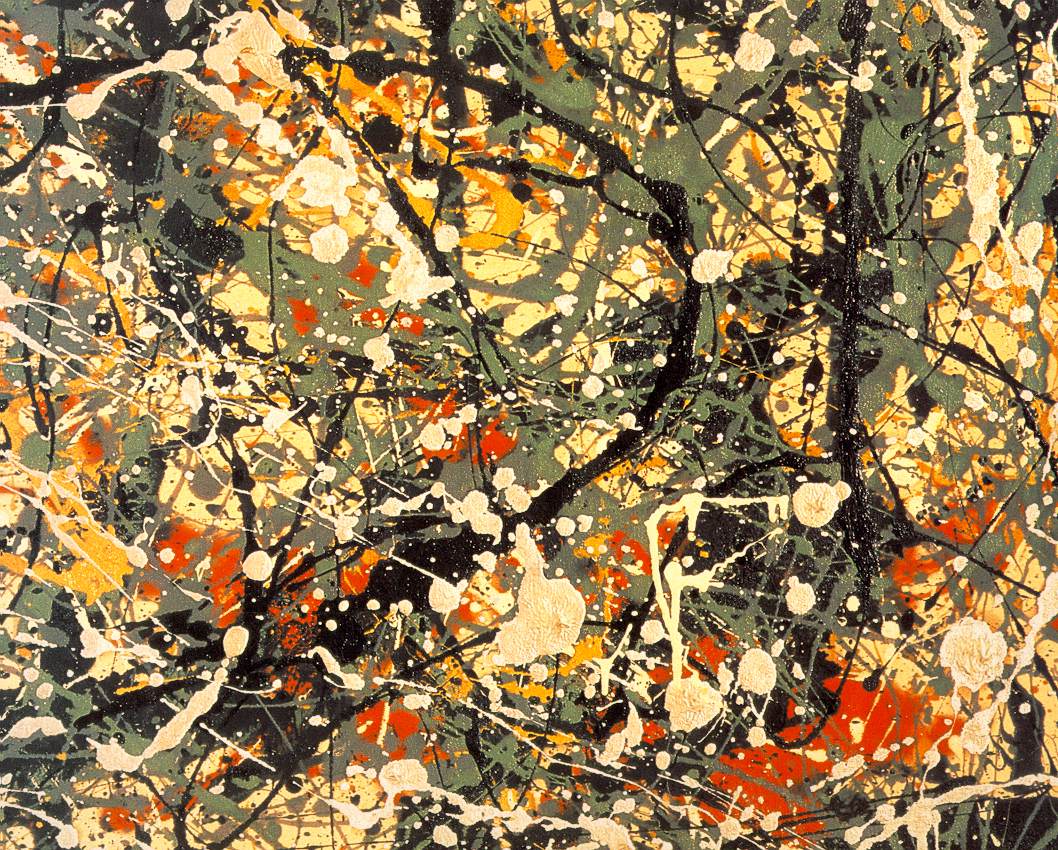
"Number 8" (1949)
- Berio doesn't intend to provoke the viewer but certainly it doesn’t leave the listener indifferent.
- He uses the graphic notation serving the artistic idea and musical needs, as a new technique. It could be compared with the technique of "action painting".
- Drip technique employed by Pollock in the "action painting" could be compared with the sign used by Berio for a sound "as short as possible."
- The feeling of chaos that can give the work of Pollock, could come to mind when listening to the Sequenza, but behind both there is an order and a technique that can only be performed by a specialist / a virtuous. Luciano Berio said about Sequenzas these works are written for "the only kind of virtuous that is acceptable today: sensitive and intelligent," adding that she must have "the highest levels of technical and intellectual virtuosity."
- The feeling of chaos that can give the work of Pollock, could come to mind when listening to the Sequenza, but behind both there is an order and a technique that can only be performed by a specialist / a virtuous. Luciano Berio said about Sequenzas these works are written for "the only kind of virtuous that is acceptable today: sensitive and intelligent," adding that she must have "the highest levels of technical and intellectual virtuosity."
- Collages
and assemblages
-
Three-dimensional charts
- Several
materials (wood, metal and plastic ...)

"Plástico rosa" (1961)
Comparison with Sequenza vii:
-The new materials Berio employ would be the new resources of the instrument (multiphonics, frulato, glissandos, harmonics ...).
- Burri goes from 2 to 3 dimensions in his paintings. Berio also breaks with the traditional writing and notes are distributed spatially within the bar.
https://sites.google.com/site/berioandsequenzaforoboe/

No hay comentarios:
Publicar un comentario